
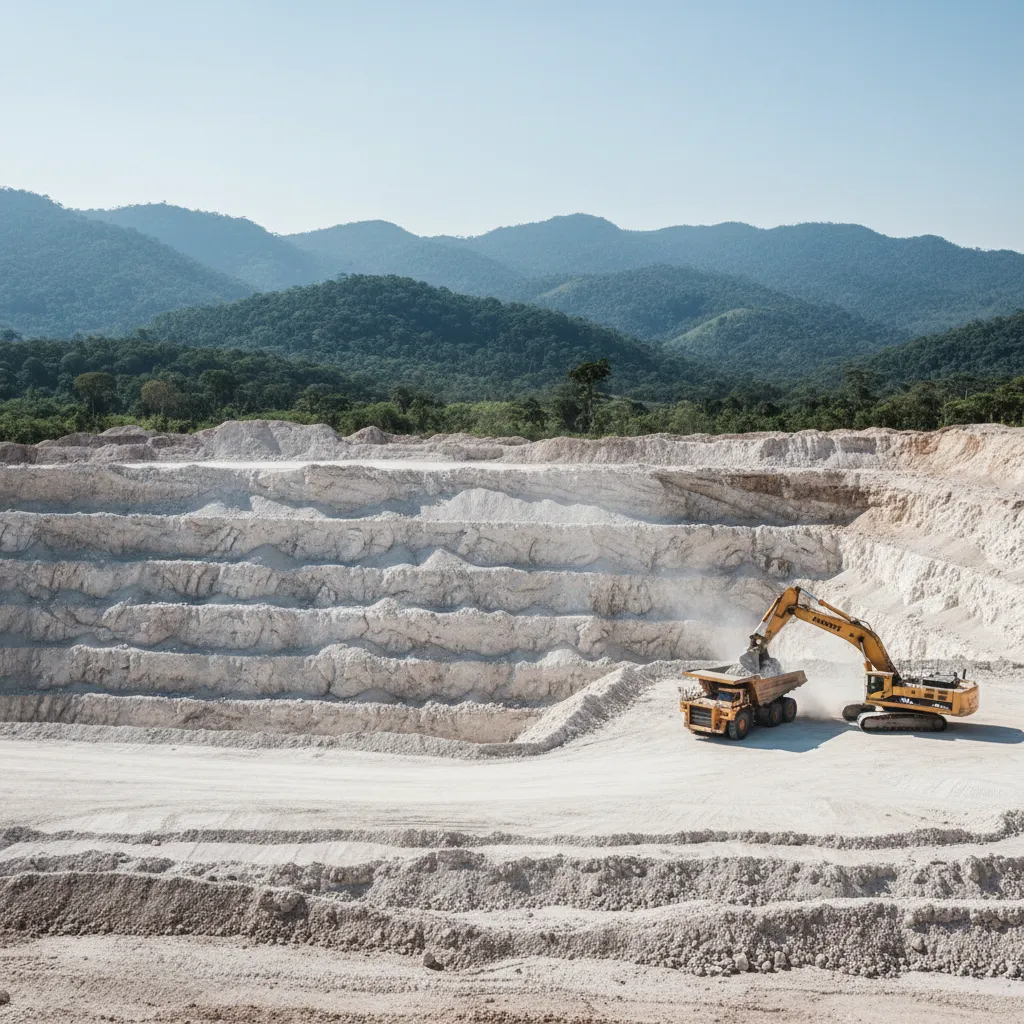
The two main pathways to lithium
Commercial lithium production comes from two principal source types.
The first is brine. Lithium-bearing brines accumulate in subsurface aquifers in arid regions — most famously the Salar de Atacama in Chile, the Salar del Hombre Muerto in Argentina, and the Salar de Uyuni in Bolivia, but also in parts of China, the United States, and elsewhere. Brine production typically involves pumping the lithium-rich brine into evaporation ponds, concentrating the lithium over many months through solar evaporation, and then converting the concentrate to battery-grade lithium carbonate or lithium hydroxide.
The second is hard rock. Hard rock lithium is mined from pegmatite deposits that contain spodumene or other lithium-bearing minerals. The ore is crushed, concentrated, and converted to a spodumene concentrate that is then chemically processed into battery-grade lithium chemicals. The largest established hard rock production has historically come from Australia, with growing contributions from a small number of other jurisdictions.
Each pathway has its strengths and weaknesses. Brine production is generally lower-cost on a cash basis but is constrained by long lead times, geographic concentration, and water-use considerations. Hard rock production has higher operating cost per tonne but typically shorter ramp-up time, more flexibility in production rate, and better placement on the cost curve under high-price conditions.
Why geographic concentration is a strategic problem
For most of the past two decades, the lithium supply base has been highly concentrated. Australia has supplied the majority of hard rock production. Chile and Argentina have supplied the majority of brine production. China has supplied the majority of conversion capacity — the chemical processing that transforms spodumene concentrate or brine into the battery-grade chemicals that cathode manufacturers actually use.
This concentration has become a strategic concern as the lithium demand profile has expanded. Battery manufacturers in North America, Europe, and Asia outside China are increasingly evaluating their supply chains under regulatory frameworks that incentivize diversified, traceable sourcing. The U.S. Inflation Reduction Act, the European Union’s Critical Raw Materials Act, and analogous frameworks in other jurisdictions reward battery supply chains that source critical minerals from politically aligned partners.
The result is a structural demand pull for lithium production capacity in geographies that are not already dominant suppliers — and for conversion capacity outside of China.
Brazil’s emerging role
Brazil has historically been a small contributor to global lithium production. The pegmatite belts of Minas Gerais and adjacent states contain meaningful spodumene resources, but the country’s regulatory framework, infrastructure, and institutional development around lithium specifically had not driven the country into the front rank of producers.
That has begun to change. Several developments have aligned to make Brazilian lithium more strategically interesting. The federal and state governments have engaged seriously with lithium as a critical mineral category. Infrastructure relevant to lithium logistics — ports, rail, and processing — has improved. International capital and technical partnerships have flowed in. And the geological endowment of Brazil’s pegmatite belt has been documented in greater detail through modern exploration techniques.
For battery supply chain participants looking to diversify sourcing geographically, Brazilian hard rock lithium offers a combination of geological prospectivity, established mining infrastructure, and a regulatory environment that has actively engaged with the strategic minerals conversation.
What investors evaluate in a hard rock lithium developer
Investors looking at hard rock lithium projects typically focus on several factors.
The resource itself is fundamental. The size of the indicated and inferred resource, the grade (typically measured in percent lithium oxide), and the mineralogy of the ore all affect the project’s economic viability. Higher grade and simpler mineralogy generally translate to lower processing cost.
The processing pathway matters. Conversion of spodumene concentrate to battery-grade lithium chemicals requires specific technical capability and capital intensity. Whether the producer plans to sell concentrate to third-party converters, build conversion capacity itself, or partner on conversion shapes the revenue profile and the capital requirement.
The offtake architecture is critical. Lithium concentrate and battery-grade chemicals can be sold under spot, contract, or long-term offtake arrangements. The structure of those arrangements determines revenue visibility and price exposure.
Infrastructure and permitting are practical determinants. A high-grade resource in a remote location with poor logistics and complex permitting can be economically marginal. A modest resource in a well-positioned jurisdiction with clear permitting pathway can be very economic.
The jurisdictional context — political stability, fiscal regime, community relations, regulatory predictability — wraps around all of the above.
The lithium price cycle and what it means
Lithium prices are famously volatile. The transition from a small, specialty-chemical-priced market to a strategic commodity has been accompanied by price moves of an order of magnitude in both directions over relatively short periods. The current cycle has seen prices surge as battery demand grew faster than supply, then correct sharply as new supply came online and demand growth moderated, then begin to find a new equilibrium.
For producers and developers, the implication is that project economics need to be robust to a wide range of price scenarios. Projects that are economic only at peak-cycle prices are vulnerable. Projects that are economic at mid-cycle prices and very profitable at peak prices are durably positioned.
Investors should similarly evaluate developer-stage projects against a range of price assumptions, not just current spot or contract prices. The relevant question is whether the project has a robust economic case across a representative price range.
What to watch in the next 12 to 24 months
Several developments will shape the lithium investment landscape over the coming period.
Battery manufacturer sourcing decisions continue to flow through to which lithium projects move forward. Long-term offtake agreements with major automakers or battery cell producers materially de-risk developer-stage projects.
Conversion capacity build-out outside of China remains a key bottleneck for the diversified supply chain. Projects with integrated conversion or with secured conversion partnerships have a structural advantage.
Policy actions — both supportive and restrictive — at the producing-country and consuming-country level continue to shape the relative economics of different supply sources.
Technology developments in cathode chemistry affect demand mix between lithium carbonate and lithium hydroxide, and between higher- and lower-grade chemical specifications.
The Brazilian lithium story is part of a larger reshaping of the global battery materials supply chain. For investors thinking about exposure to that reshaping, hard rock lithium projects in well-positioned jurisdictions outside the historical concentration of supply are one of the more direct ways to participate.
All coverage Atlas LithiumATLXDisclosure
This article is independent editorial content and reflects the author's opinion and analysis as of the date of publication. It is not investment advice and should not be relied on as the basis for any investment decision. MicroCap Desk and its contributors received no compensation of any kind — cash, securities, or otherwise — from any company mentioned, or from any third party, in connection with this article. The author holds no position in any security mentioned. Information is drawn from sources believed reliable but is not guaranteed accurate or complete. Microcap securities carry a high risk of loss. Do your own research. See our full Disclosure.