
Why fire seasons have changed
The factors driving the shift in fire activity are well documented and broadly understood. Longer dry seasons, hotter average summer temperatures, accumulated fuel loads from decades of fire suppression, and the increasing extent of the wildland-urban interface — the geography where development meets forested or grassland landscape — have together produced fire seasons that are both more dangerous and more economically consequential.
The federal land management agencies in the United States, the provincial agencies in Canada, and the state-level emergency management agencies that bear primary responsibility for wildfire response have had to expand their capabilities to keep pace. That expansion has largely been a procurement story: contracting for more ground crews, more retardant capacity, more incident command resources, and more aerial firefighting capability.
What aerial firefighting actually does
Aerial firefighting is not a single capability but a portfolio of specialized aircraft and operational doctrines. The most prominent capabilities include:
Air tankers — large fixed-wing aircraft that drop fire retardant chemicals in front of advancing fires to slow their spread. The strategic role of a retardant drop is to give ground crews time and space to build containment lines.
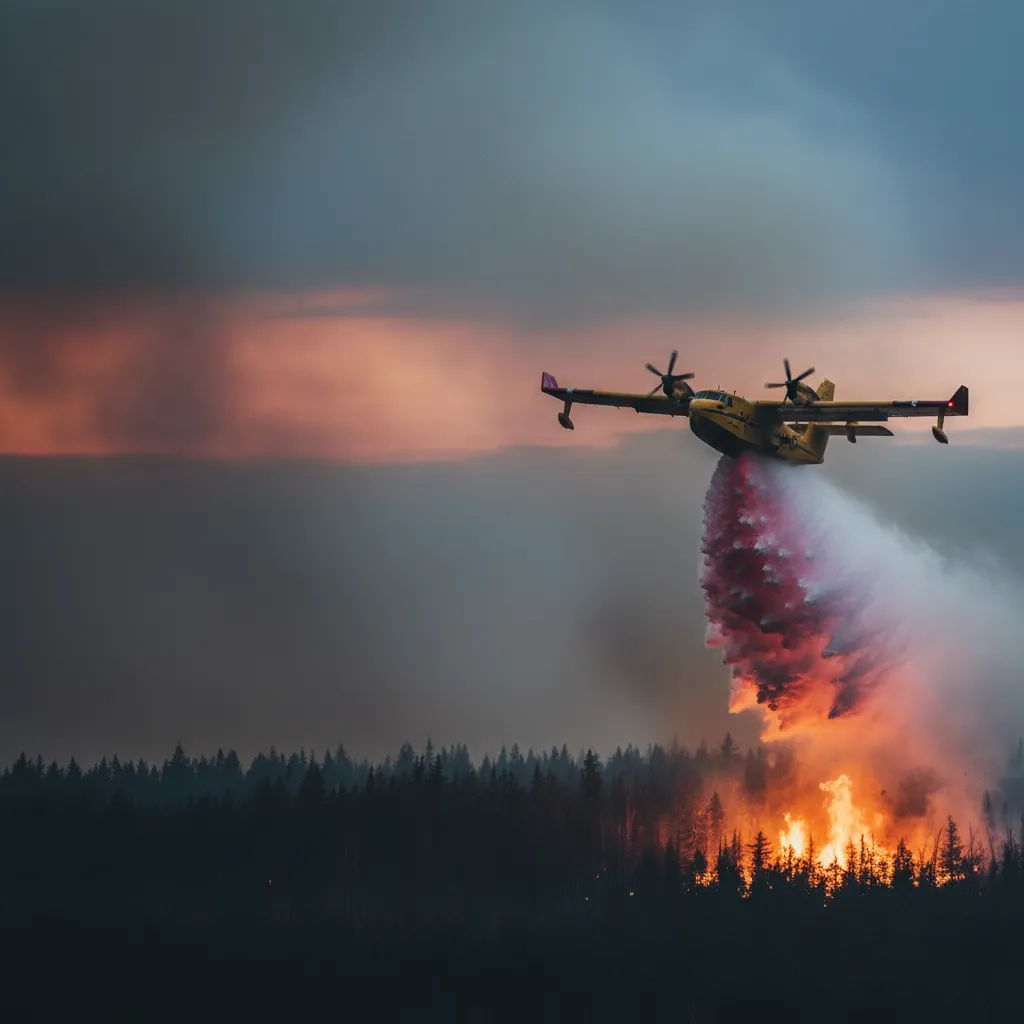
Water-scooping aircraft — typically twin-engine amphibious aircraft that scoop water from lakes or other water bodies and drop it directly on fires. Unlike retardant-dropping tankers, scoopers can refill from local water sources and execute multiple drops per hour, giving them a particular role in initial attack on fires near suitable water.
Helicopters — used for water and retardant drops, for inserting and extracting ground crews, for reconnaissance, and for managing logistics in difficult terrain.
Lead planes and air attack platforms — smaller aircraft that direct the tactical use of the larger aircraft and coordinate with ground operations.
Single-engine air tankers — smaller fixed-wing aircraft used in initial attack and for sustained operations in specific geographic contexts.
Each of these capabilities has its own operating profile, cost structure, and tactical role. The integrated use of multiple aircraft types under unified incident command is what produces effective aerial firefighting.
The economics of the contracting model
Aerial firefighting services are generally provided to government agencies under contracts that combine a fixed availability fee with a variable use-based fee. The availability fee compensates the contractor for keeping aircraft, crews, and maintenance support ready for deployment throughout the fire season. The use-based fee compensates for actual hours flown or drops made.
This structure means that the revenue model for aerial firefighting contractors has both a stable component — the availability fees that are paid regardless of fire activity — and a variable component that scales with actual fire activity in any given season. The relative weight of those components depends on the specific contract terms.
The contracting parties are typically federal agencies (the U.S. Forest Service, the Department of the Interior), state agencies (Cal Fire and equivalents), provincial agencies in Canada, and various international agencies. Some contractors also serve commercial customers, including utilities and private landowners with significant wildfire exposure.
Why utilities and insurers have become more interested
A development worth understanding is the involvement of electric utilities and property insurers as direct or indirect customers of fire suppression services. Several major U.S. utilities have faced substantial liability and operational disruption from wildfires associated with their infrastructure, and they have made significant investments in fire mitigation and suppression capability. Insurers, facing rising claims from wildfire-related losses in fire-exposed regions, have similarly become more engaged with prevention and suppression infrastructure.
The implication is that the customer base for aerial firefighting services is expanding beyond traditional government agencies into private-sector buyers with their own urgent commercial reasons to want effective response capability.
What investors should think about
For investors evaluating companies in the aerial firefighting category, several considerations are central.
Fleet composition and capability mix matters. Different aircraft types have different operating profiles, contracting markets, and capital requirements. A diversified fleet across capability types gives a contractor more flexibility in pursuing contracts and managing utilization across seasons.
Geographic exposure is significant. Fire activity varies meaningfully across regions and across seasons. Contractors with operating bases in multiple geographies can shift assets to where the activity is and capture revenue across a longer effective season.
Contract structure determines revenue visibility. Multi-year contracts with major federal agencies provide a baseline of revenue regardless of fire activity in any single year. Spot contracts and short-term arrangements can produce upside in active seasons but with less visibility.
Maintenance, training, and crew availability are the operational realities of the business. The capital cost of the aircraft is large, but the operational cost of keeping crews trained and aircraft mission-ready is substantial and continuous.
Regulatory and procurement dynamics shape the longer-term picture. Agency procurement strategies, certification requirements for new aircraft types, and the integration of remotely piloted aircraft into fire suppression operations are all relevant.
The longer-term picture
Aerial firefighting is one of the categories where the underlying demand drivers — climate, fuel accumulation, wildland-urban interface expansion, infrastructure vulnerability — are pointing in a single direction for the foreseeable future. The annual variability of fire seasons is high, but the multi-year trend in total fire activity is firmly upward in most relevant geographies.
For companies positioned in the category, the operating environment is one of steadily increasing demand for capability that has limited substitution. Aerial firefighting is one of the very few situations where the only effective alternative to deployed aircraft is more deployed aircraft. That is the structural foundation of the industry’s expansion.
For investors, the category combines the visibility of long-term government contracting with the cyclical variability of actual fire activity, against a multi-year demand backdrop that has very few mitigating forces. It is one of the more direct ways to take exposure to the wildfire infrastructure story.
All coverage Bridger AerospaceBAERDisclosure
This article is independent editorial content and reflects the author's opinion and analysis as of the date of publication. It is not investment advice and should not be relied on as the basis for any investment decision. MicroCap Desk and its contributors received no compensation of any kind — cash, securities, or otherwise — from any company mentioned, or from any third party, in connection with this article. The author holds no position in any security mentioned. Information is drawn from sources believed reliable but is not guaranteed accurate or complete. Microcap securities carry a high risk of loss. Do your own research. See our full Disclosure.