
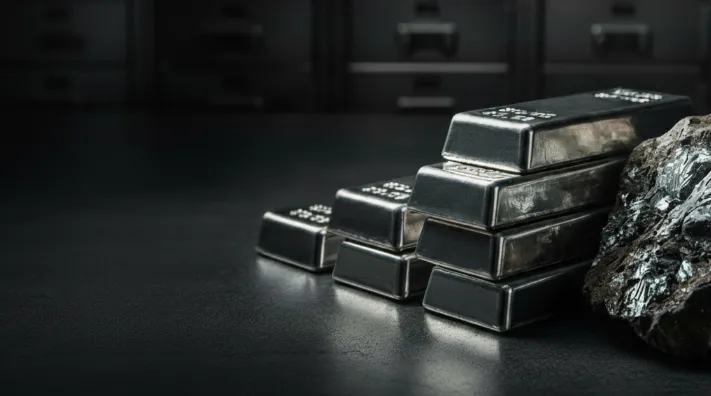
The two demand stories
Gold is roughly 90 percent investment, jewelry, and central-bank holdings, with only a small fraction going to industrial use. Silver is the inverse for industrial demand: in recent years, industrial applications have accounted for roughly half of total annual silver consumption, with the remaining demand split among jewelry and silverware, investment bars and coins, and photographic uses.
That industrial share has been rising. The structural driver is photovoltaic solar panel manufacturing. Crystalline-silicon solar cells use silver paste for the conductive lines that collect the electrical current generated by the cell. Silver content per cell has been engineered down over time, but cell volume has grown so rapidly that total silver consumption in photovoltaics has expanded substantially.
The second large industrial demand category is electrical and electronic uses outside of solar. Silver has the highest electrical and thermal conductivity of any metal, and it is used in switches, contacts, conductive inks, RFID antennas, and a long list of specialty applications. The growth of vehicle electrification, data center build-out, and 5G infrastructure has expanded these demand streams.
A third category is medical and antimicrobial applications, which use silver’s biocidal properties in wound dressings, coatings, water treatment, and consumer goods.
Investment demand — the monetary side — adds to industrial demand to produce total silver consumption. When investors buy silver bars, coins, and exchange-traded products, that demand is incremental to whatever the solar industry, the electronics industry, and the medical-device industry are consuming.
Why the supply side is constrained
Silver is rarely mined as a primary product. Approximately 70 to 75 percent of the world’s mined silver comes as a by-product of other metals — primarily lead, zinc, copper, and gold mining. That structural feature has important consequences.
The first is that silver supply is partly inelastic to silver price. If silver prices double, base-metal miners do not automatically double their silver output, because the economics of their operations are driven by the primary metal, not by silver.
The second is that the pipeline of new primary silver production has been thin. The exploration and development environment for primary silver projects has been challenging through several years of subdued prices, and large new primary silver mines coming online in any given year is the exception rather than the rule.
The third is that silver inventories at exchanges and bullion warehouses are finite. When industrial and investment demand both rise simultaneously, drawdowns from above-ground stocks can become significant.
Mexico’s role in global silver
Mexico has been the world’s largest silver producer for most of the past century. The country’s silver belt — running through the central and northern states — has been mined since the 16th century, and several of the world’s largest silver mines are located there. Mexico’s mining sector benefits from long-established expertise, deep infrastructure, and well-developed labor markets, although the regulatory environment has evolved in ways that investors monitor closely.
Within Mexico, the historical silver district extending from Zacualpan through Taxco and into Guerrero and the State of Mexico has produced silver for centuries and contains numerous deposits at various stages of exploration and production. The deposits in this region are typically epithermal vein systems — narrow, high-grade veins that have been mined selectively for hundreds of years and that often contain underexplored extensions and parallel structures.
What investors evaluate in a silver miner
For investors looking at silver-focused mining companies, several factors typically come into focus.
The first is the resource — total contained silver, grade, and whether the production is primary silver or comes as a by-product of base metals. Primary silver miners have more direct exposure to silver price than by-product producers.
The second is operating cost — measured most commonly as all-in sustaining cost per silver ounce, net of any base-metal credits. Lower-cost producers can remain profitable through price weakness; higher-cost producers are more leveraged to price moves in either direction.
The third is jurisdictional factors — permitting environment, fiscal regime, infrastructure access, and labor conditions. These vary substantially across silver-producing countries and even within them.
The fourth is the production profile — current output, near-term growth from existing operations, and the development pipeline of exploration projects that could feed future production. Miners with both producing assets and meaningful exploration upside can deliver returns through two distinct channels.
The outlook
Looking forward, the demand picture for silver is shaped by a small number of large variables. Solar capacity additions globally are expected to continue growing through the 2020s, with the rate of growth depending on policy, financing, and module pricing. Vehicle electrification continues to expand silver demand in connectors, switches, and electronic components. Data center build-out and AI infrastructure represent a newer demand vector that is still being quantified.
On the supply side, the lack of large new primary silver projects in the development pipeline is well documented in industry-data publications such as the annual World Silver Survey produced by Metals Focus for the Silver Institute. Base-metal mining capacity additions will continue to produce by-product silver, but those volumes are not directly responsive to silver-price signals.
The result is a market with strong, multi-source demand growth and a constrained supply side — a setup that tends to support pricing over time, though not in a straight line. Silver’s price volatility is famously higher than gold’s, and the dual identity that makes it interesting also makes it temperamental.
For an investor with patience and an appetite for cyclicality, silver offers a kind of exposure that combines industrial-economy growth with monetary-asset characteristics in a way few other commodities do.
Disclosure
This is editorial coverage. MicroCap Desk has received no compensation from IMPACT Silver Corp. for this article, has not been paid to publish it, and holds no position in IPT at time of publication. This piece is reporting and analysis, not investment advice.
Figures and characterizations reflect IMPACT Silver Corp.'s public disclosures and publicly available industry information. Readers should consult primary documents before making any investment decision.