
The traditional cycle
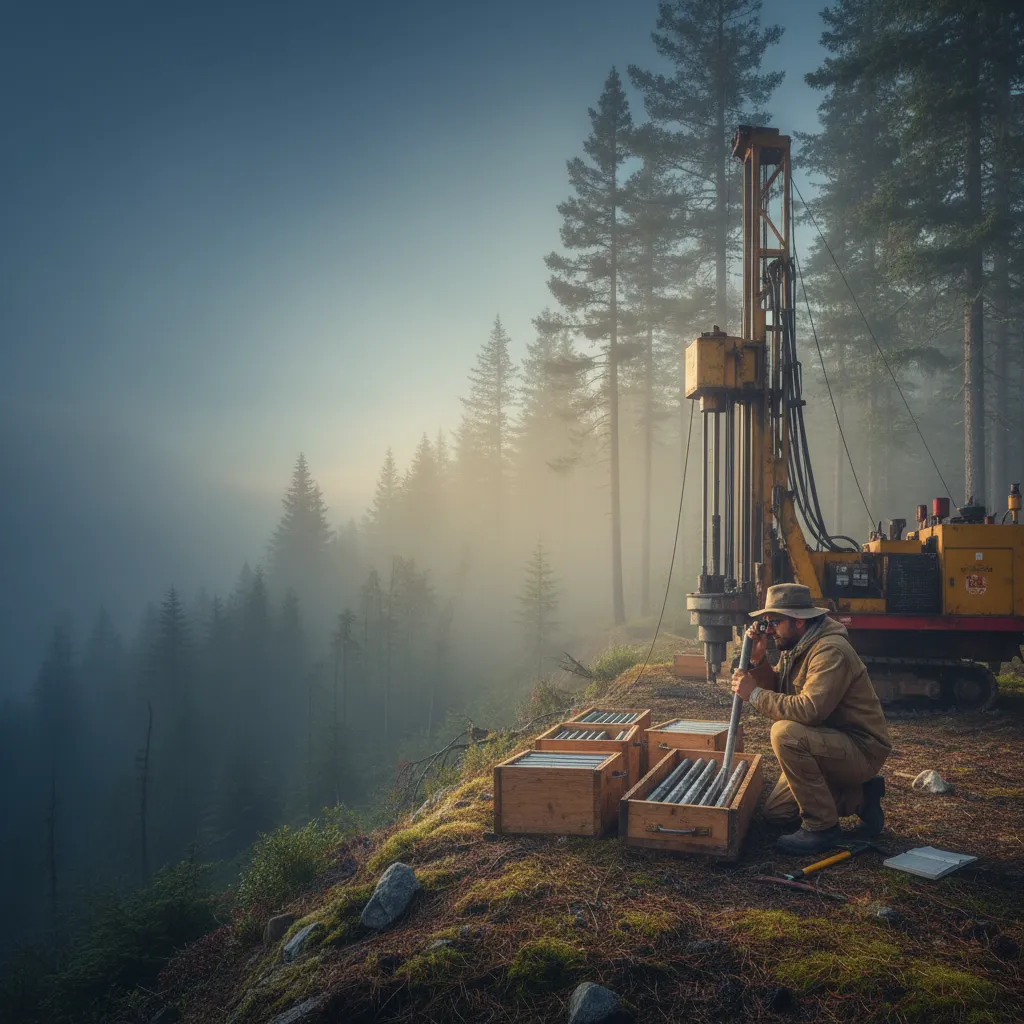
The path from initial discovery to gold production has historically involved a recognizable sequence. Early-stage exploration identifies mineralization through geochemical and geophysical work. Drilling defines the geometry and grade of the deposit. Resource estimation produces a quantitative description of the contained metal at varying confidence levels (inferred, indicated, measured). Engineering and metallurgical studies (preliminary economic assessment, pre-feasibility, feasibility) progressively refine the project economics. Permitting secures the legal right to develop and operate. Financing arranges the capital needed for construction. Construction builds the mine and processing infrastructure. Commissioning brings the operation online.
This sequence has not changed fundamentally. But each of its steps has tended to require more time and more capital than it did in past decades.
Why the cycle has lengthened
Several factors have contributed to the longer development cycle.
Permitting timelines have expanded materially. Environmental review processes are more rigorous and consultative than they were a generation ago. Indigenous community engagement, where applicable, is a more formal and lengthier process. Federal, state or provincial, and local permitting authorities each have their own review processes, and projects often need approvals from multiple levels concurrently. The cumulative effect is that the permitting phase of a mid-sized to large gold project frequently takes five to ten years from initial submission to final permit.
Capital intensity has risen. The size and complexity of modern gold processing facilities, the standards for water management and tailings storage, and the workforce and equipment costs have all grown. The total capital cost of building a mid-tier gold mine has risen substantially in real terms over recent decades.
The deposits being developed today are, on average, lower-grade and more metallurgically complex than those developed in earlier generations. As the highest-grade, simplest deposits have been mined out, the remaining inventory tends to require more sophisticated processing and more capital to produce a given ounce of gold.
ESG and stakeholder expectations have expanded the scope of what is required for a project to proceed. Community development commitments, biodiversity assessments, climate-related disclosures, and other dimensions of project planning have become standard requirements rather than optional considerations.
Capital markets discipline has also affected the pace at which projects advance. Investors have become more demanding about specific economic and risk metrics before financing decisions, and projects with marginal economics or significant unresolved risks have more difficulty securing the necessary capital.
What this means for junior companies
The combination of longer timelines and higher capital requirements has reshaped the economics of junior gold exploration and development companies.
The traditional model — discover, drill out, sell to a major — still exists but has become more selective. Major gold producers are looking for projects that are not just geologically attractive but also positioned to navigate the longer development timeline. Projects in friendly jurisdictions with clearer permitting paths, with management teams that have demonstrated the ability to execute through that timeline, and with deposits of sufficient size to justify the capital investment are favored.
For juniors that intend to develop projects to production themselves, the capital requirement has become a more formidable barrier. Equity financing alone is often insufficient. The financing structure typically combines equity, debt, streaming agreements (where a financier provides upfront capital in exchange for a future share of gold production), and potentially royalty arrangements. The optimal financing mix depends on the specific project economics and the developer’s strategic objectives.
What investors evaluate in a junior gold company
For investors evaluating junior gold exploration and development companies, several considerations are central.
The asset itself is the foundation. The size of the resource (measured in contained ounces), the grade, the metallurgical complexity, and the geological setting all affect the project’s economic viability.
The jurisdictional context matters substantially. Different countries and even different regions within countries have very different regulatory environments, fiscal regimes, infrastructure conditions, and security situations. The Fraser Institute Annual Survey of Mining Companies and similar publications attempt to systematically rank jurisdictional attractiveness; while imperfect, they provide a useful structured view.
Management quality is critical. Junior gold companies live or die on the experience and execution of their management teams. Teams that have taken projects through permitting, financing, and construction have demonstrated capabilities that are difficult to replace.
The capital structure and balance sheet position determine flexibility. Junior companies that have manageable debt loads and adequate cash to fund near-term work programs are in a different position than those that need to raise capital immediately into challenging markets.
The development pathway and strategic intent shape what investors are buying. Some juniors aim to develop projects to production; others aim to discover and define resources for sale to majors; others operate as exploration vehicles with diversified portfolios. Each pathway has its own risk and return profile.
The gold price environment
The gold price environment shapes everything. When prices are strong, marginal projects become economic, financing becomes easier, and the entire sector benefits. When prices are weak, the opposite occurs, and even strong projects can struggle.
For investors with a longer-term view, the question is less about timing the gold price and more about identifying projects whose economics are robust across a reasonable range of price scenarios. Projects that are economic at mid-cycle prices and very profitable at peak prices have a different risk profile than projects that work only at peak prices.
The structural backdrop
The longer-term picture for gold mining is shaped by several persistent forces.
Central bank purchases of gold have been a meaningful component of demand in recent years, with several emerging market central banks notably increasing their gold reserves.
Investment demand through exchange-traded products and physical bar and coin purchases continues to be a significant component of total demand.
Jewelry demand, primarily from India and China, is the largest single category but is more price-sensitive than investment demand.
On the supply side, production from the world’s largest gold mines is generally not growing meaningfully. Several long-producing operations are approaching the end of their economic lives, and new large discoveries are increasingly rare. The structural picture is one of constrained primary supply against multiple sources of underlying demand.
For junior gold companies positioned in attractive jurisdictions with sound projects and capable management, the operating environment combines real challenges with real opportunities. The longer development cycle is a fact of the modern industry; companies that have built their plans around it are positioned to navigate it successfully.
Disclosure
This is editorial coverage. MicroCap Desk has received no compensation from ONGold Resources Ltd. for this article, has not been paid to publish it, and holds no position in ONGRF at time of publication. This piece is reporting and analysis, not investment advice.
Figures and characterizations reflect ONGold Resources Ltd.'s public disclosures and publicly available industry information. Readers should consult primary documents before making any investment decision.