
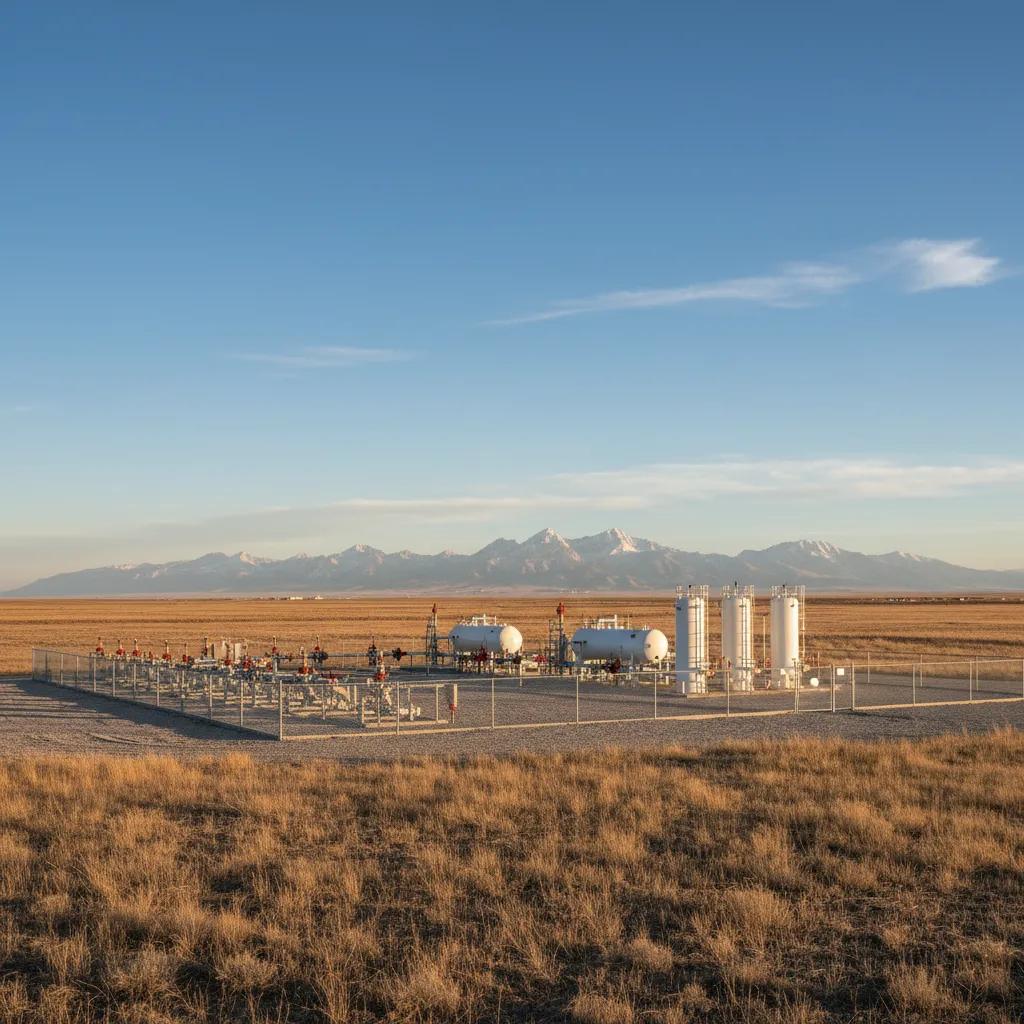
The basin’s history
The Wattenberg field was discovered in 1970 and entered conventional production in subsequent years. Through the 1970s and 1980s, the field was developed primarily through vertical wells targeting specific producing sandstone intervals. The geology of the basin — multiple stacked producing zones at moderate depths in a structurally favorable setting — supported sustained activity through cycles of higher and lower oil and gas prices.
The shift to horizontal drilling and hydraulic fracturing in the 2000s transformed the basin. The Niobrara formation and the Codell formation, both of which had been recognized for decades as sources of hydrocarbons but had not been economically producible at scale, became the primary horizontal drilling targets. The basin’s production grew substantially through the 2010s, peaking at over 500,000 barrels of oil per day plus significant associated gas production.
In recent years, the basin’s overall activity has been more modest than at its peak, but the resource base remains substantial and the operating environment has matured in ways that affect what kinds of producers can succeed.
The regulatory environment
One of the distinguishing features of the DJ Basin is the regulatory framework under which it operates. Colorado has, over the past several years, established what is arguably the most rigorous regulatory regime for oil and gas operations in any major U.S. producing state.
The Colorado Oil and Gas Conservation Commission (now the Colorado Energy and Carbon Management Commission) was substantially restructured under state legislation that explicitly broadened its mission to include protection of public health, safety, welfare, the environment, and wildlife resources. Setback requirements, methane emission standards, water management requirements, and a range of other operational standards have been tightened.
For producers, this regulatory environment translates into specific operational realities. Permitting timelines are longer than in some other basins. Operational standards are more rigorous. The cost of compliance is higher. The pace at which new development can proceed is slower than the pure resource economics would suggest.
The flip side is that producers that have built operational capability in this environment have demonstrated a kind of competence that is portable to other jurisdictions that may evolve in similar directions.
The current operating dynamic
The DJ Basin today is characterized by several specific features.
The major producers in the basin have consolidated over the past decade. Several producers that had been active in the basin during the development peak have exited or substantially reduced their position. Other producers have built scale through acquisition and have become the dominant operators.
Inventory quality across the basin varies significantly. The highest-productivity acreage in the core of the Wattenberg field supports robust well economics; lower-productivity acreage in the basin’s flanks has more challenging economics.
The takeaway capacity for both oil and gas produced in the basin has been adequate in most periods, though localized constraints have at times affected realized pricing for some operators.
The water management challenges in the basin are significant. The volumes of produced water generated by horizontal wells require disposal capacity that has been constrained at times. The induced seismicity concerns that have shaped water disposal regulations in some other basins have been less acute in the DJ but remain a relevant consideration.
Why the basin continues to matter
Despite the regulatory complexity and the maturity of much of the producing area, the DJ Basin remains relevant to U.S. oil and gas production for several reasons.
The resource base is substantial. Independent estimates of remaining technically recoverable resource in the basin run into the billions of barrels of oil equivalent. Activity at a measured pace can sustain meaningful production for decades.
Operating costs in the basin, for producers with the right operational capability, are competitive with other onshore U.S. basins. The combination of moderate well depths, established infrastructure, and proximity to consuming markets supports favorable economics.
The basin’s location near growing demand centers — Front Range population growth in Colorado, the Mountain West region more broadly, and connections to the broader Mid-Continent system — provides advantages in market access that some other basins do not have.
The expertise of the workforce, service providers, and supporting infrastructure has developed over decades. This ecosystem is an asset that supports continued activity.
What investors should think about
For investors evaluating DJ Basin producers, several considerations are useful.
Acreage position quality is foundational. The basin is not uniformly productive, and the location of an operator’s acreage within the basin materially affects well economics and inventory depth.
Operational capability in the Colorado regulatory environment is a real differentiator. Producers that have built the systems, relationships, and processes needed to operate efficiently in this environment have an advantage over those that have not.
Capital efficiency, measured in metrics like cost per producing well and capital efficiency per BOE of new production, varies across operators in the basin.
Hedging discipline matters in a commodity-price environment that has been volatile for years.
The capital structure of any DJ Basin producer, including debt levels and the financial flexibility to navigate cycles, is part of the investment case.
The broader picture
The DJ Basin is one of several mature onshore U.S. basins that continues to play a meaningful role in U.S. oil and gas production even though it does not generate the headline numbers of the Permian. The basin’s combination of substantial remaining resource, established infrastructure, and operational expertise makes it a durable contributor to U.S. supply.
For producers focused on the basin, the operating environment combines a real resource opportunity with a regulatory complexity that requires specific operational capability. For investors, the basin represents a different exposure profile than the leading shale plays — one that involves slower development pace, more rigorous operating standards, and longer-life producing assets in a politically engaged operating environment.
All coverage Prairie OperatingPROPDisclosure
This article is independent editorial content and reflects the author's opinion and analysis as of the date of publication. It is not investment advice and should not be relied on as the basis for any investment decision. MicroCap Desk and its contributors received no compensation of any kind — cash, securities, or otherwise — from any company mentioned, or from any third party, in connection with this article. The author holds no position in any security mentioned. Information is drawn from sources believed reliable but is not guaranteed accurate or complete. Microcap securities carry a high risk of loss. Do your own research. See our full Disclosure.