
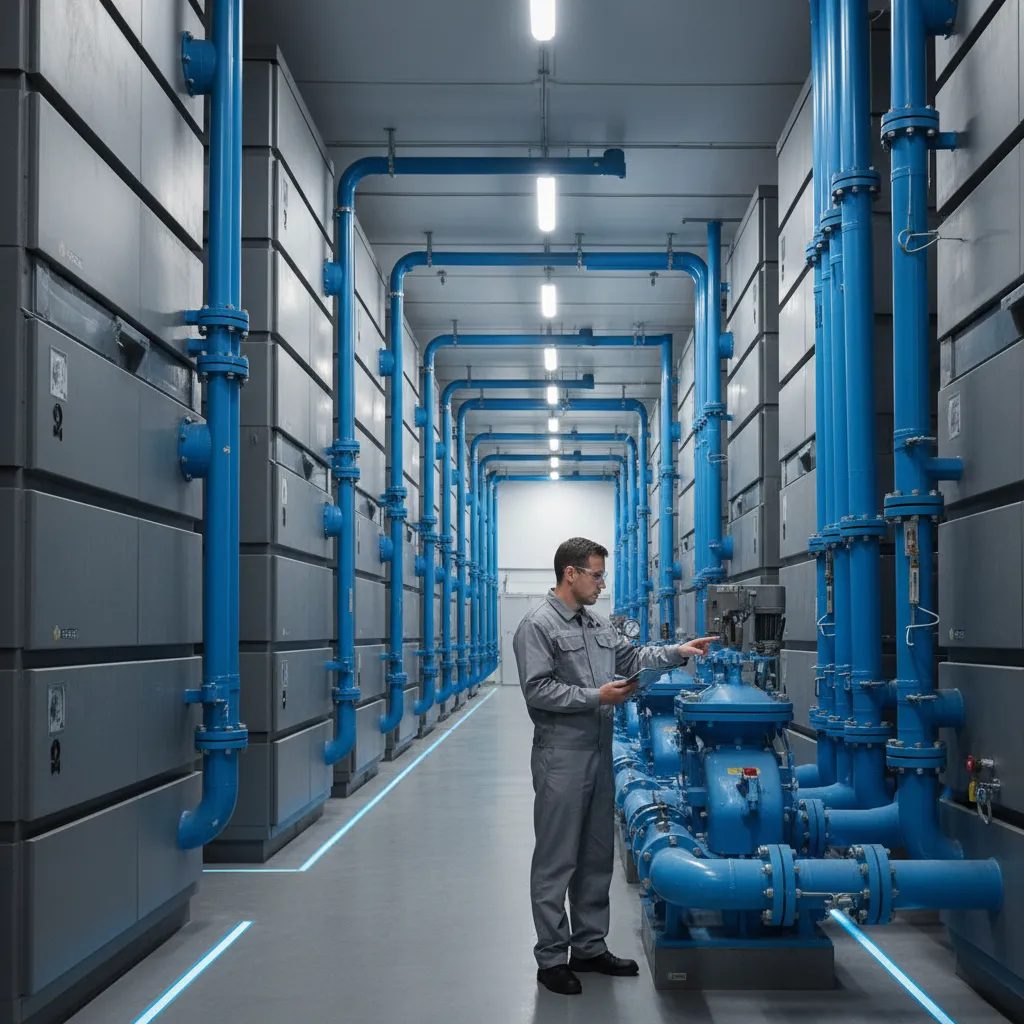
What vanadium redox flow batteries are
A vanadium redox flow battery, often abbreviated VRFB, stores energy in two tanks of vanadium-based electrolyte. The electrolyte is pumped through a cell stack where the actual charge and discharge reactions take place. Unlike a lithium-ion battery, where the energy storage and the power generation happen inside the same sealed cell, a flow battery separates the two.
That separation has a specific consequence: power capacity (measured in megawatts) and energy capacity (measured in megawatt-hours) can be scaled independently. To increase power output, you add more cell-stack surface area. To increase energy storage duration, you add more electrolyte. Lithium-ion batteries cannot do this — adding hours of storage means adding proportionally more cells, with all the associated cost and complexity.
For applications that need to discharge for many hours rather than just one or two, the flow architecture has structural advantages.
Why long-duration storage matters
Most of the early-stage battery storage deployments on the grid have been one- to two-hour systems. Those systems are well suited to frequency regulation, peak shaving, and managing short-duration mismatches between generation and demand. They are not well suited to handling multi-day weather variability, seasonal mismatches, or the kind of sustained discharge that solar-heavy grids will eventually need to manage the evening ramp.
The long-duration energy storage market — generally defined as systems capable of discharging for four hours or more, with growing interest in eight- to twelve-hour and longer applications — is widely projected to be one of the fastest-growing segments of the broader energy storage market over the next decade. The reason is straightforward: as the share of variable renewable generation on a grid rises, the duration of storage needed to maintain reliability rises with it.
Several public agencies and independent research organizations have published forward-looking studies on long-duration storage demand. The U.S. Department of Energy’s Long Duration Storage Shot initiative explicitly targets cost reductions for storage systems with discharge durations of 10 hours or more. The International Energy Agency, BloombergNEF, and academic institutions have produced similar projections.
Where vanadium sits relative to alternatives
Vanadium redox flow batteries are one of several long-duration storage candidates. Others include other flow chemistries (iron-flow, zinc-bromine, organic flow), compressed-air systems, gravity-based storage, thermal storage, and lithium-iron-phosphate (LFP) systems optimized for longer discharge.
Each of these technologies has strengths and weaknesses, and there is no consensus that one will dominate. The realistic outcome is that different chemistries will fit different applications based on location, duration requirements, cost profile, and project economics.
Vanadium’s specific advantages include extremely long cycle life (the electrolyte does not degrade with cycling), inherent fire safety relative to lithium chemistries, and the ability to deep-cycle without performance loss. The disadvantages include higher upfront capital cost per kilowatt-hour, the physical footprint of the electrolyte tanks, and exposure to vanadium price volatility.
The capital cost question is the central commercial debate. Vanadium electrolyte represents a meaningful share of total system cost, which means VRFB economics are partly determined by the vanadium market itself.
The vanadium market beyond batteries
Approximately 90 percent of global vanadium consumption today goes into steel — specifically high-strength low-alloy steel used in construction, automotive, and infrastructure applications. China is the largest single producer and consumer of vanadium for steel.
The growth of VRFB demand introduces a new demand source for vanadium that is independent of steel-cycle dynamics. The size of that new demand source depends on how many VRFB systems get deployed, but if long-duration storage builds out at the rate that several forecasts suggest, vanadium consumption from batteries could grow into a meaningful share of total demand over time.
Vanadium supply is somewhat concentrated. The largest producers operate in China, Russia, South Africa, and Brazil. As a result, supply-chain considerations — including the desire of Western utilities and developers to source vanadium from politically aligned jurisdictions — have become a factor in project planning.
Brazil in particular has emerged as a strategically interesting producing region. Several of the largest single primary vanadium producing assets outside of China are located there, with established mining and processing infrastructure.
What investors look at in a vanadium producer
When evaluating a vanadium producer in the context of both the steel market and the emerging energy storage opportunity, investors typically consider several factors.
Production cost relative to peers is foundational. Lower-cost producers can remain profitable through cyclical weakness; higher-cost producers benefit disproportionately from price recoveries.
The mix of upstream production (mining and processing concentrate) versus downstream value-added products matters because higher-purity vanadium products and electrolyte-specific formulations command higher prices.
Direct exposure to the energy storage opportunity — through electrolyte supply agreements, manufacturing partnerships, or integrated battery products — represents an option on the growth of the VRFB market that pure mining producers do not have.
Capital structure, balance sheet position, and the ability to fund through cyclical periods round out the picture.
The bigger picture
The story for vanadium is not that flow batteries will displace lithium-ion at scale. Lithium has its place and will keep it. The story is that long-duration storage is going to be needed, that it will be served by a portfolio of technologies, and that vanadium redox flow batteries are one of the more credible candidates for the multi-hour and multi-day duration range.
If that vision plays out, vanadium has a use case that is unlike anything in its historical market — and producers positioned to serve both the established steel demand and the emerging energy storage demand have an option set that did not exist a decade ago.
All coverage LargoLGODisclosure
This article is independent editorial content and reflects the author's opinion and analysis as of the date of publication. It is not investment advice and should not be relied on as the basis for any investment decision. MicroCap Desk and its contributors received no compensation of any kind — cash, securities, or otherwise — from any company mentioned, or from any third party, in connection with this article. The author holds no position in any security mentioned. Information is drawn from sources believed reliable but is not guaranteed accurate or complete. Microcap securities carry a high risk of loss. Do your own research. See our full Disclosure.